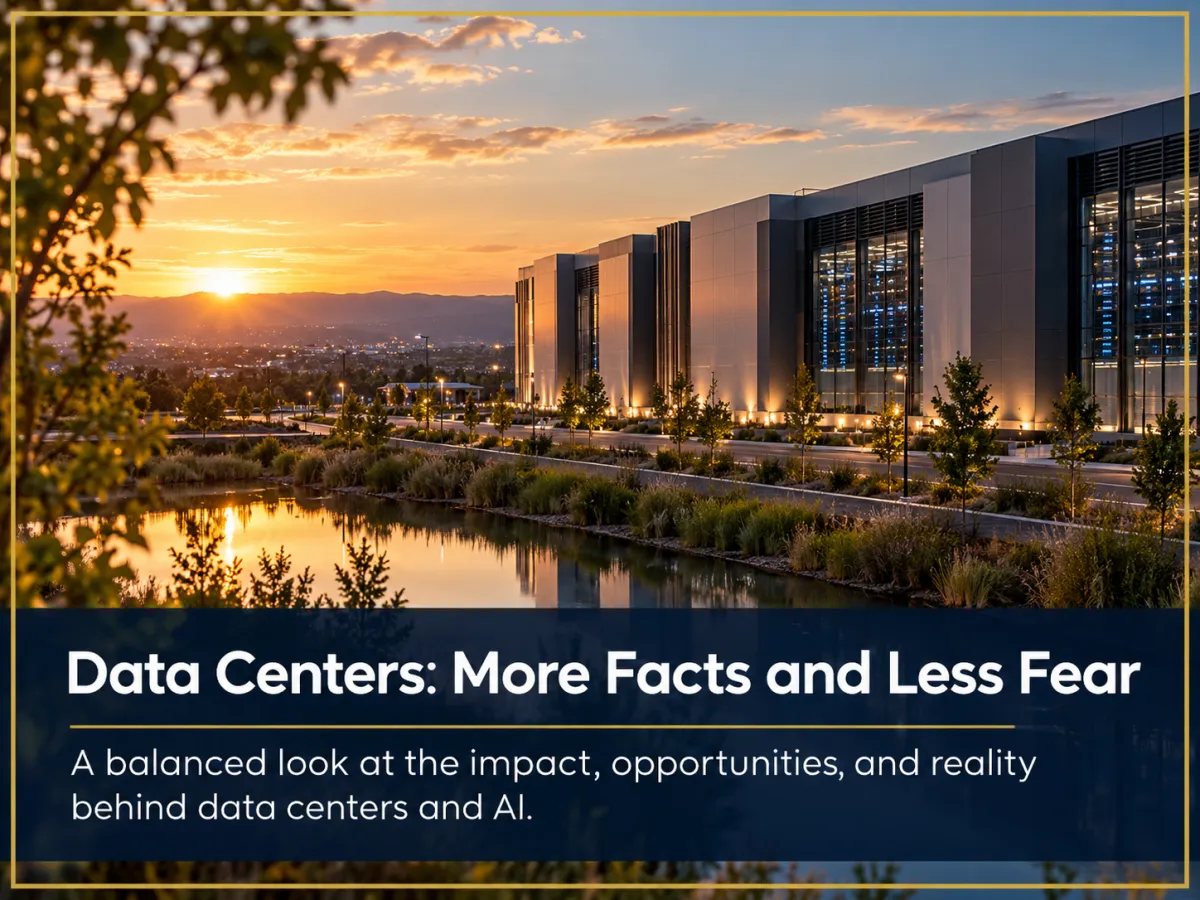
Data Centers: More Facts and Less Fear in 2026
TL;DR: Every search, stream, video call, and AI tool you use runs on physical computing infrastructure somewhere. Data centers deserve serious scrutiny on water, electricity, and community impact, but they also power drug research, small business productivity, and economic development. The real question is not whether data centers are good or bad. It is what a specific facility produces for the resources it consumes. Contact Peak Capital Mortgage at (970) 577-9200 to talk through how AI and infrastructure investment are reshaping real estate markets in your area.
Key Takeaways
Every time you stream a movie, use AI, process a payment, or search the internet, you are using a data center. The debate about whether to build them is separate from the fact that we are already dependent on them
U.S. data centers consumed an estimated 17.4 billion gallons of water in 2023. U.S. golf facilities used approximately 531 billion gallons for irrigation in 2024. Context matters when evaluating resource consumption
The World Economic Forum's 2025 Future of Jobs report estimated that AI and broad economic changes could create 170 million jobs globally by 2030 while displacing 92 million, for a net gain of approximately 78 million
AI is giving small businesses access to research, marketing, analytics, and automation that previously required much larger teams and much more capital, which can meaningfully level a competitive landscape historically tilted toward large organizations
Data center construction generates jobs across dozens of trades, and operating facilities create ongoing technical, security, and management employment plus potential property-tax revenue for host communities
What Do Data Centers Actually Do?
There is something ironic about a social media post arguing we should stop building data centers.
Where do we think that post is being stored, processed, and distributed from?
Every time you stream a movie, store photos in the cloud, join a video call, search the internet, use an AI tool, process a payment, or pull up information on your phone, you are relying on physical computing infrastructure somewhere.
Data centers are not some abstract technology operating outside your daily life.
You are already using them.
That does not mean every proposed data center should be automatically approved. There are legitimate questions around water use, electricity consumption, land use, noise, infrastructure demand, tax incentives, and what a major facility does to a surrounding community.
But the starting point for that conversation should be facts, not a conclusion reached before the analysis begins.
One consistent mistake in the data-center debate is measuring only what these facilities consume without accounting for what they produce.
Artificial intelligence and advanced computing are being used in medicine, drug development, disease research, manufacturing, logistics, finance, engineering, and countless other fields.
The FDA has already seen hundreds of drug-development submissions containing AI components. Regulators have acknowledged the potential for AI to improve drug development, reduce time to market, improve toxicity and effectiveness predictions, and ultimately improve healthcare outcomes.
That computing has to happen somewhere.
If AI helps a research team identify a disease sooner, develop a drug faster, or reduce waste in a manufacturing process, there is real economic and human value being created on the other side of the electricity and water being consumed. That is the part of the equation that often gets left out.
Will AI Eliminate Everyone's Jobs?
The prediction that AI will eliminate enormous numbers of jobs and leave people with nothing to do gets a lot of attention.
Technology absolutely will eliminate or substantially change some jobs. That has happened with nearly every major technological advancement.
Farm machinery reduced the number of people required to produce food. Computers eliminated many clerical processes. ATMs changed banking. The internet transformed retail, publishing, travel, and advertising.
The work changed, but new industries and occupations developed around the technology.
We do not know exactly how AI will affect employment, and history does not guarantee any particular outcome. But current forecasts do not support the idea that humanity simply runs out of work.
The World Economic Forum's 2025 Future of Jobs report estimated that broad economic and technological changes could create 170 million jobs globally by 2030 while displacing 92 million, producing a net gain of approximately 78 million positions.
That is where the message to younger people matters. Rather than teaching them to fear AI, teach them how to use it. Learn the technology. Understand how it multiplies productivity. Figure out which human skills become more valuable alongside it, not less.
Can AI Level the Playing Field for Small Businesses?
This may be one of the more genuinely exciting shifts the technology is producing.
Historically, large companies had significant advantages because they could afford research departments, programmers, analysts, attorneys, marketing teams, sophisticated software, and large information resources. A small business couldn't match that.
AI is beginning to change the equation.
One individual can now access research, analyze information, develop marketing content, automate repetitive work, build software, improve customer service, and create workflows that previously required substantially more people and capital.
It does not completely eliminate the advantages of scale. But it gives smaller businesses and individuals access to capabilities that were once available primarily to large organizations.
That is a meaningful and potentially democratizing shift.
How Does Data Center Water Use Compare to Other Industries?
Water consumption is one of the most commonly cited concerns, and it deserves serious consideration.
U.S. data centers directly consumed an estimated 17.4 billion gallons of water in 2023. That number sounds large.
Context matters.
U.S. golf facilities applied approximately 531 billion gallons of water in irrigation in 2024.
That comparison is not an argument that golf courses are bad or that data centers are automatically justified. It demonstrates why a number without context rarely tells you what you need to know.
The same analytical caution applies elsewhere. You may have heard the claim that producing one almond requires about a gallon of water. A peer-reviewed study of California almonds estimated an average total water footprint closer to 3.2 gallons per almond, though that calculation includes different categories of water and should not be directly compared with a data center's municipal water consumption.
The more useful question is not just how much water something uses. It is what value is being created in exchange for the resource being consumed. That framing produces a much more productive conversation than simply pointing at a large number.
Is Electricity the Bigger Challenge for Data Centers?
Electricity deserves the same serious analysis that water does.
Data centers use a significant amount of electricity, and that demand will grow as AI and computing capabilities expand.
You cannot simply plug massive new loads into an aging electrical grid and assume nothing changes.
But increased demand can also become a catalyst for something the U.S. already needs: more generation capacity, better transmission, improved storage, and a more modernized and resilient electrical infrastructure.
We are already seeing increased interest in microgrids, dedicated generation, battery systems, nuclear power, natural gas generation, and other approaches that supply these facilities without placing the full burden on an existing grid.
Some data-center developments are also exploring ways that backup generation and stored electricity could potentially support the broader electrical system during peak demand periods.
Technology also continues to improve. More efficient chips, better cooling systems, and closer integration of power generation into data-center development all reduce the footprint per unit of computing output over time. Projections about future impact should account for those improvements rather than assuming every future facility will operate exactly like today's.
What Economic Activity Do Data Centers Create for Local Communities?
There is an economic dimension to data centers that tends to get overlooked in debates focused on resource consumption.
These facilities represent enormous capital investment. Building them requires construction workers, electricians, engineers, HVAC professionals, equipment operators, concrete contractors, plumbers, security systems, fiber-optic infrastructure, utility work, and numerous other trades.
Once operating, they require ongoing technical, security, maintenance, mechanical, and management personnel. There can also be property-tax revenue and secondary economic activity as wages and business spending circulate through the surrounding community.
That said, communities should still look carefully at the specifics. How many permanent jobs will remain after construction? What is the realistic property-tax contribution? What does the community receive in exchange for zoning approvals, tax incentives, and infrastructure support?
The right question is not "data centers are bad, stop them" or "AI is the future, approve everything." The right question is what the overall impact on a specific community actually looks like, both positive and negative, measured honestly.
FAQ
Do data centers use an irresponsible amount of water? U.S. data centers consumed an estimated 17.4 billion gallons of water in 2023, which is a significant figure. But context is essential. U.S. golf course irrigation used approximately 531 billion gallons in 2024. The more productive question is not the absolute amount of water used, but what value is being created by that consumption and whether the facility is using water responsibly given what it produces for the community and the broader economy.
Will AI create or destroy more jobs overall? Both, but the current evidence points to a net gain. The World Economic Forum's 2025 Future of Jobs report projected that AI and broad economic changes could create approximately 170 million jobs globally by 2030 while displacing around 92 million, for a net gain of about 78 million positions. Technology historically transforms work rather than eliminating it entirely. The most productive preparation is building familiarity with AI tools and understanding which skills become more valuable alongside them.
What economic benefits do data centers bring to communities? Data center construction requires workers across dozens of skilled trades, from electricians and engineers to concrete contractors and fiber-optic specialists. Operating facilities create ongoing employment in technical, security, and management roles, and they can generate property-tax revenue and secondary economic activity. Communities should evaluate specific proposals carefully, asking how many permanent jobs are actually created, what the real tax contribution looks like, and what concessions or incentives are being offered in exchange.
The Bottom Line
Data centers already power the technology you use every day. The conversation about whether and how to build them should start with an honest accounting of both the resources they consume and the value they produce: for medicine, for small businesses, for communities, and for economic development. Fear-based opposition and unconditional enthusiasm both miss the point. Are you tracking how AI and infrastructure investment are affecting real estate values and market activity in your area? Contact Peak Capital Mortgage to talk through what these shifts mean for buyers, owners, and investors.