Is a New Economic Paradigm Emerging in 2026?
Key Takeaways
Negative narratives dominate financial commentary, but markets and economies adapt in underestimated ways
U.S. energy dominance and UAE production expansion could create downward pressure on energy prices
AI is creating a productivity revolution that could drive naturally deflationary growth
Lower inflation and productivity gains could push long-term rates and mortgage rates lower
GDP growth of 5% to 6% becomes plausible when innovation and private investment lead
Are We Missing the Powerful Forces Driving Growth?
Much of the recent financial commentary has been dominated by negative narratives.
Higher oil prices.
Persistent inflation concerns.
Geopolitical tensions.
Government debt.
Questions about economic growth.
Turn on almost any financial news program, and you will hear discussions centered around what could go wrong. While risks certainly exist, markets and economies often underestimate their ability to adapt.
What if the focus is on the wrong things?
What if investors, businesses, and consumers are so focused on today's challenges that they are missing the powerful forces that could drive the next phase of economic growth?
History has shown that major economic transformations rarely arrive with universal agreement. They often emerge while the majority is still focused on yesterday's problems.
Today may be one of those moments.
Consider one potential scenario.
How Are Supply Shocks Working Through the System?
The inflation surge of the past couple of months is heavily influenced by supply shocks.
Geopolitical conflicts have created uncertainty, leading to global supply chain disruptions and volatility in energy markets.
As those disruptions gradually work their way through the system, the inflationary pressure they created begins to fade.
At the same time, the United States has become an energy powerhouse.
The U.S. now produces more oil than Russia and Iran combined. This is a remarkable shift from where the country stood just a couple of decades ago.
Energy remains one of the foundational inputs for nearly every aspect of the economy. Lower and more stable energy costs ripple through transportation, manufacturing, agriculture, and consumer goods.
That alone can help reduce inflationary pressures.
How Is the UAE Becoming a New Growth Engine?
Another development receiving little attention is the strategic shift in the Middle East taking place in the United Arab Emirates.
Many view the UAE through the lens of oil production, but its leadership is playing a much longer game.
The UAE's decision to leave OPEC was not simply about producing more oil. It was about recognizing that its long-term economic objectives were becoming incompatible with OPEC's production limits. The country has committed to aggressively expanding its oil production capacity at a time when many forecasts suggest global oil demand could peak sometime around 2040.
The UAE wants to monetize its vast energy reserves while demand remains strong. It is seeking to maximize revenues over the next decade and deploy that capital into building a permanent post-oil economy.
Where is that money going?
Technology.
Artificial intelligence.
Data infrastructure.
Advanced logistics.
The UAE is positioning itself to become a global AI compute and innovation hub. The country is investing heavily in the infrastructure required to support the next generation of artificial intelligence development.
Instead of viewing oil as the future, the UAE views oil as the funding mechanism for the future.
The result could be increased global energy supply at a time when much of the world remains concerned about inflation and energy shortages. More production capacity creates downward pressure on energy prices.
The investment of energy profits into artificial intelligence and advanced technologies creates an entirely new engine for economic growth in the Middle East.
If successful, this could help support lower energy prices globally.
Could Inflation Fall Below 2%?
If energy costs moderate and supply chains continue normalizing, inflation could fall below the Federal Reserve's long-term target.
Many consumers struggle to imagine this after the inflationary environment of recent years.
But economic cycles often swing from one extreme to another.
What appears impossible today can become obvious in hindsight.
Lower inflation would reduce pressure on households that have been fighting rising costs for years.
How Is AI Creating a Productivity Boom?
This may be the most underestimated force in the economy today.
Artificial intelligence is not simply another technology trend.
It is a productivity revolution.
Businesses are already using AI to automate tasks, improve customer service, streamline operations, reduce labor costs, and accelerate decision-making.
What happens when those productivity gains begin appearing across thousands of industries simultaneously?
Costs decline.
Efficiency improves.
Output increases.
Historically, productivity gains have been one of the most powerful drivers of economic growth.
Unlike inflationary growth, productivity-driven growth allows businesses to produce more while keeping costs contained.
That creates a naturally deflationary force throughout the economy.
Why Could Long-Term Rates Move Lower?
If inflation falls and productivity rises, long-term bond yields could move lower.
The 10-year Treasury yield could potentially move below 4%.
Lower Treasury yields generally support lower mortgage rates.
Mortgage rates returning to their three-year lows would have significant implications.
Housing affordability would improve.
Refinancing activity would accelerate.
Households could reduce monthly obligations.
Consumer confidence could strengthen.
The housing market would likely see renewed activity after years of affordability challenges.
What Happens When These Forces Combine?
Now combine all these factors:
Lower energy costs
Lower inflation
Higher productivity
Lower borrowing costs
Improved housing activity
Increased business investment
The result could be economic growth that surprises nearly everyone.
GDP growth in the 5% to 6% range, once viewed as unrealistic, becomes much more plausible when productivity and private sector investment become the primary drivers.
This is very different from growth driven by government spending.
This is growth driven by innovation.
Why Should We Look Beyond the Headlines?
None of this is guaranteed.
Markets rarely move in straight lines, and economic forecasts are often wrong.
But it is important to remember that the future is rarely created by consensus thinking.
Major opportunities emerge when people focus on what could go right while others fixate on what could go wrong.
Today, there is no shortage of negative narratives competing for attention.
Yet beneath those headlines, powerful forces are reshaping the economy.
The next economic chapter may look very different from the one many people are expecting. The key is remaining open to the possibility that the future could be far better than the headlines suggest.
FAQ
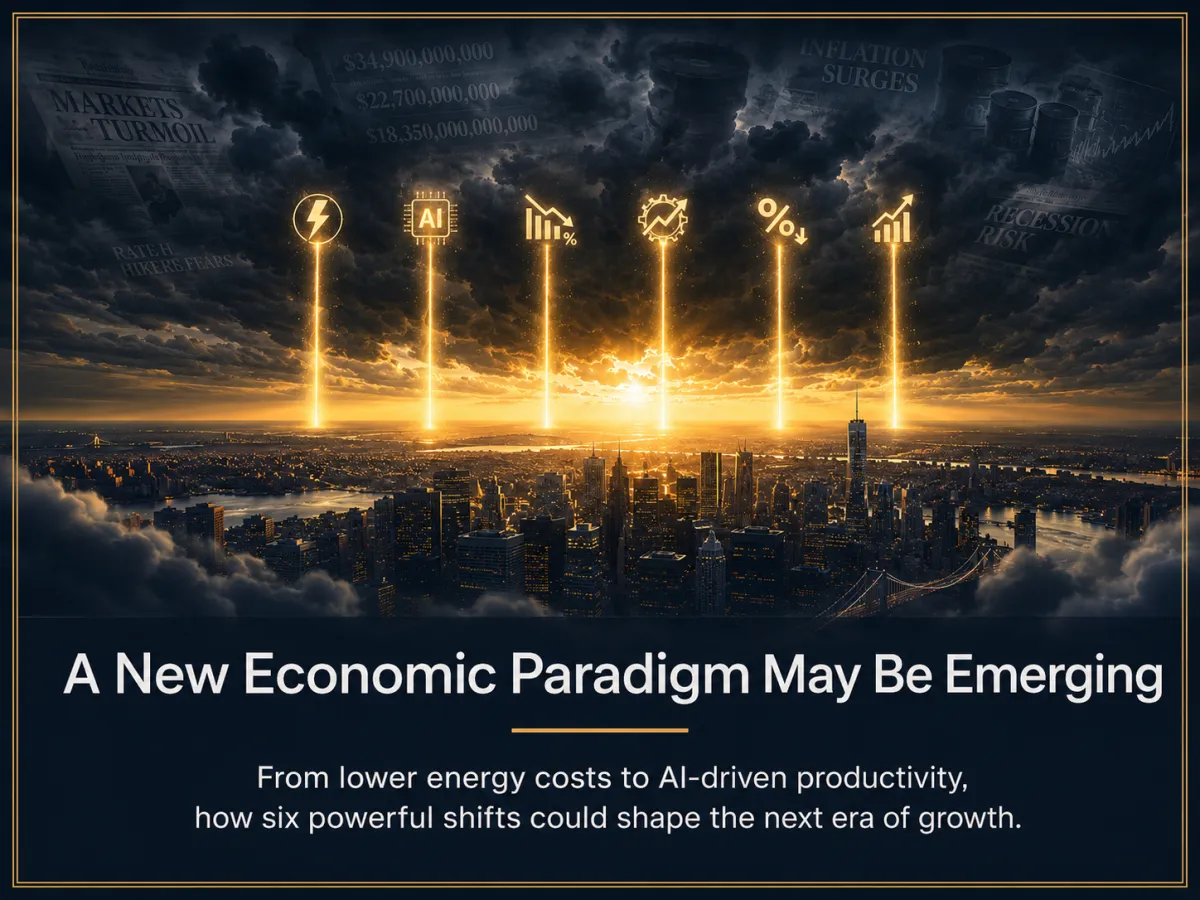
What are the six forces that could drive a new economic paradigm? Lower energy costs, normalizing supply chains, falling inflation, AI-driven productivity gains, lower long-term interest rates, and accelerating private sector investment. Together, these forces could drive GDP growth of 5% to 6%.
How does AI create deflationary growth? AI improves productivity by automating tasks, streamlining operations, and reducing costs. Unlike inflationary growth, productivity-driven growth allows businesses to produce more while keeping costs contained, creating a naturally deflationary force.
What would lower inflation mean for mortgage rates? If inflation falls below the Fed's 2% target and productivity rises, long-term Treasury yields could decline. Lower Treasury yields generally support lower mortgage rates, improving housing affordability and accelerating refinancing activity.
The Bottom Line
While negative narratives dominate financial commentary, powerful forces may be reshaping the economy beneath the headlines. Lower energy costs, AI-driven productivity, and falling inflation could combine to drive economic growth that surprises everyone. The future may be far better than the headlines suggest.
Ready to position yourself for improving market conditions? Contact Peak Capital Mortgage to discuss how lower rates and improved affordability could benefit your homebuying or refinancing plans.
Peak Capital Mortgage. This information is for educational purposes. Consult financial professionals for personalized guidance.