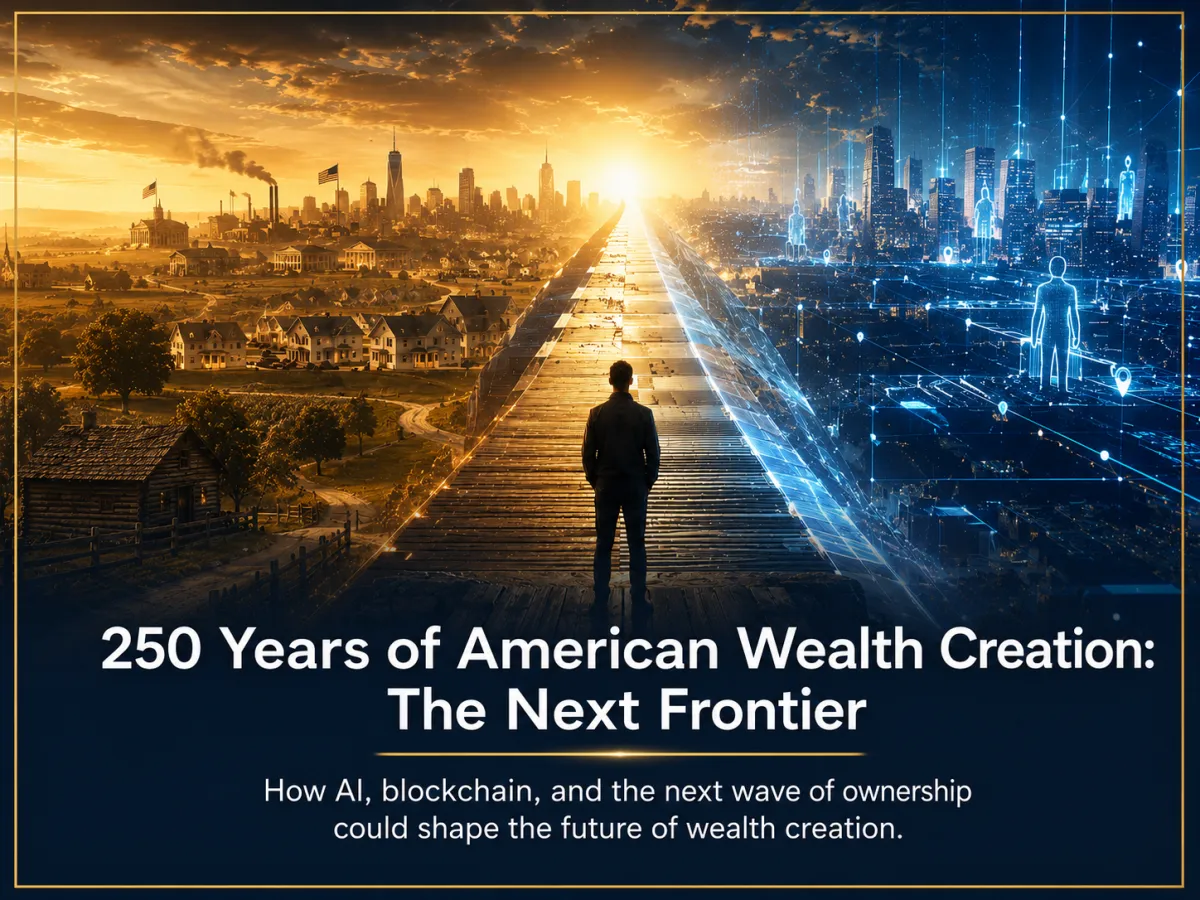
250 Years of American Wealth Creation: The Next Frontier
TL;DR: The first 250 years of American wealth creation were defined by expanding access to ownership, from land to homes to financial markets. The next era will be shaped by AI, blockchain, tokenization, and entirely new forms of ownership that are only beginning to emerge. The principle that has held constant across every era: those who participate in ownership participate in growth. Contact Peak Capital Mortgage at (970) 577-9200 to make sure real estate is part of your ownership strategy today.
Key Takeaways
Blockchain and tokenization are making fractional ownership of previously inaccessible assets possible, potentially democratizing investing the way the mortgage democratized homeownership
AI is already transforming financial analysis, investment management, and business operations, and the next evolution into agentic AI systems that execute tasks could reshape how wealth is created
Real estate itself is entering a new era: blockchain could streamline title transfers, smart contracts could automate transactions, and AI could simplify underwriting and reduce closing timelines
Every major economic revolution in American history created wealth for those who recognized the change early and positioned themselves to participate in ownership of what came next
The principle that has held constant across 250 years remains unchanged: ownership creates opportunity, whether that ownership is land, a home, a stock, or a digital asset
What Will Ownership Look Like Over the Next 250 Years?
The first 250 years were defined by expanding access to ownership.
Each generation benefited from innovations that made ownership more accessible and allowed more Americans to participate in economic growth.
As we celebrate the nation's 250th anniversary, it is worth asking an important question: what will ownership look like over the next 250 years?
The answer may be very different from anything we have experienced before.
How Is Technology Redefining Who Can Own What?
Throughout history, ownership has often been limited by capital.
If you wanted to own an apartment building, a shopping center, valuable artwork, or a private company, significant financial resources were required. Most opportunities were available only to institutions or wealthy investors.
Technology is beginning to change that.
Blockchain technology and tokenization are creating the possibility of fractional ownership of assets that were previously inaccessible. Instead of purchasing an entire building, investors may own a fraction. Instead of needing millions to invest in a private company, investors may gain exposure through tokenized ownership structures.
Ownership is becoming more accessible.
Just as the mortgage helped democratize homeownership in the twentieth century, blockchain may help democratize asset ownership in the twenty-first century.
How Will Artificial Intelligence Change Wealth Creation?
Artificial intelligence may prove to be one of the most important wealth-building technologies in history.
Unlike previous technological advances that primarily improved physical productivity, AI enhances intellectual productivity. It allows individuals and businesses to accomplish more with fewer resources.
Already we are seeing AI assist with:
Financial analysis
Investment management
Business operations
Marketing
Software development
Customer service
The next evolution is agentic AI. These systems do not simply answer questions. They perform tasks, execute workflows, and help make decisions.
Individuals who learn how to leverage these tools may be able to operate at levels of productivity previously reserved for large organizations. This could dramatically reshape how wealth is created.
How Is Real Estate Entering Its Next Evolution?
Real estate itself will undergo significant changes.
Mortgage lending remains heavily dependent on processes developed decades ago. Title transfers often require multiple parties and extensive manual verification. Settlement timelines can take weeks.
The future will look very different.
Blockchain technology could streamline ownership records. Smart contracts could automate transactions. Artificial intelligence could simplify underwriting and risk analysis.
The result would be faster closings, lower costs, and increased transparency. Homeownership itself may become easier and more efficient than ever before.
The underlying principle remains unchanged. Ownership matters. The tools simply evolve.
How Are Financial Markets Becoming More Accessible?
One of the greatest trends of the next generation may be the continued democratization of investing.
Historically, information was controlled by institutions. Today, investors have access to more information than at any point in history. Tomorrow, they may have AI-powered financial agents helping them:
Analyze investments
Monitor risk
Rebalance portfolios
Identify opportunities
Explain strategies
Managing wealth may become dramatically simpler while becoming more sophisticated at the same time. This has the potential to level the playing field for millions of investors.
What Does the Next Industrial Revolution Look Like?
Technology is not simply changing finance. It is changing everything.
Artificial intelligence. Robotics. Quantum computing. Advanced manufacturing. Space commercialization. Energy innovation.
Many of these developments are still in their early stages. Yet they have the potential to create entirely new industries and investment opportunities.
Every major economic revolution throughout history has created wealth for those who recognized the change early and positioned themselves accordingly. The coming decades may be no different.
What Has Stayed Constant Across 250 Years of American Wealth Creation?
While technology changes, one principle has remained remarkably consistent throughout American history.
Ownership creates opportunity.
In 1776, ownership often meant land. In 1900, ownership increasingly meant homes and businesses. In 1950, it expanded through the modern mortgage system. Today, ownership includes stocks, businesses, real estate, and digital assets. Tomorrow, it may include entirely new forms of ownership that have not yet been imagined.
The tools evolve. The opportunities evolve. The technology evolves.
But the fundamental principle remains: those who participate in ownership tend to participate in growth.
What Should You Take from America's Next Chapter?
The story of America has always been a story of innovation, adaptation, and opportunity.
The first 250 years created one of the greatest wealth-building systems the world has ever seen. The next 250 years will likely be shaped by technologies and industries that are only beginning to emerge today.
No one can predict exactly what that future will look like. But history provides an important lesson.
The greatest opportunities often emerge during periods of transformation. As America begins its next chapter, the future of wealth creation may not be about working harder. It may be about understanding where the world is heading and positioning yourself to participate in the ownership opportunities that follow.
FAQ
What is tokenization and how could it change investing? Tokenization uses blockchain technology to divide ownership of a physical or financial asset into digital shares that can be bought and sold. A commercial building worth millions could theoretically be split into thousands of tokens, letting smaller investors own a fraction. This mirrors how the stock market democratized ownership of large companies, applied now to real estate, art, and other previously illiquid asset classes.
How will AI change the mortgage process for homebuyers? AI is already improving underwriting speed and accuracy by analyzing more data points faster than traditional systems. The next step, agentic AI, could coordinate the entire closing process: ordering title, verifying income, scheduling appraisals, and flagging issues before they delay closing. The result for buyers would be faster timelines, lower costs, and a less stressful experience.
Is real estate still a good foundation for wealth building in the AI era? Yes. The tools will change, but the core mechanics of real estate wealth creation, leverage, equity accumulation through principal paydown, and long-term appreciation, are not going away. If anything, technology that speeds up transactions and lowers costs makes real estate more accessible, not less relevant.
The Bottom Line
For 250 years, the Americans who built lasting wealth were the ones who understood what ownership meant in their era and got access to it. Land in 1776. Homes in 1950. Stocks and businesses in the late twentieth century. The next era will bring new forms of ownership and new tools to access them. But real estate, the asset class that powered middle-class wealth creation for generations, remains one of the strongest foundations you can build on today. Ready to make ownership part of your next chapter? Contact Peak Capital Mortgage to explore your options.