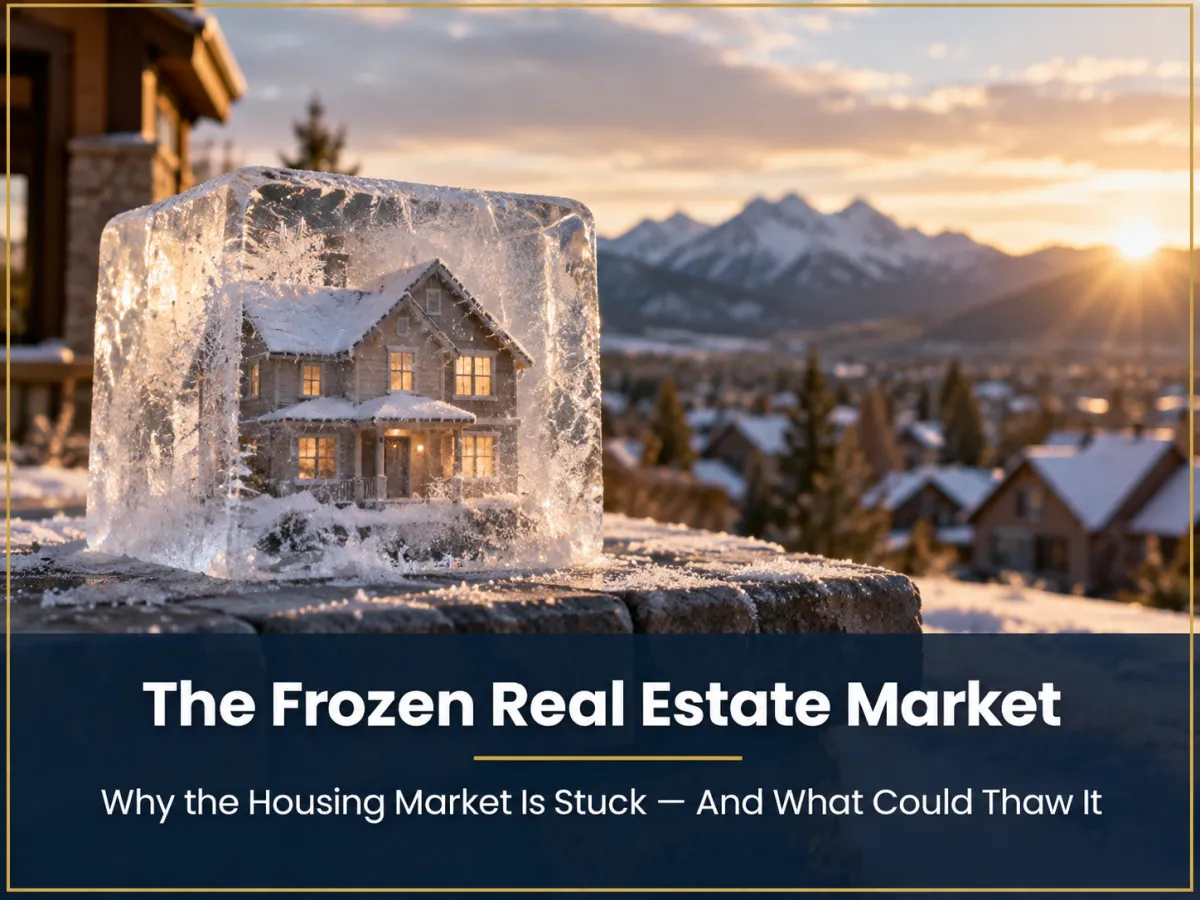
The Frozen Real Estate Market: Why Housing Is Stuck and What Could Thaw It in 2026
TL;DR: The real estate market is stuck. Low inventory, mortgage rates near 6.67 percent, a 4-million-home supply gap, and millions of homeowners handcuffed to low-rate loans they will not give up are all reinforcing each other at the same time. The market does not need a crash or a return to 3 percent rates to break free. It needs the pieces to start moving back toward balance, and lower rates are the most likely catalyst. Contact Peak Capital Mortgage at (970) 577-9200 to talk through how to position yourself before that happens.
Key Takeaways
Active listings in July 2026 remained approximately 11.6 percent below typical 2017 to 2019 levels, keeping supply tight even as buyer demand has softened
Existing home sales fell 1.7 percent in July to an annualized pace of 4.06 million homes, yet the median existing home sale price still rose to $431,400, a clear signal that low supply is holding prices up
The 30-year fixed mortgage rate stood at 6.67 percent as of August 13, 2026, according to Freddie Mac, pricing out a meaningful share of potential buyers
Millions of homeowners are effectively rate handcuffed: they would consider selling, but cannot rationalize giving up a 3 percent mortgage for a 6 percent one, which removes inventory from the market
NAR estimated that a rate decline from 7 to 6 percent could add approximately 5.5 million households to the pool of buyers who could afford the median-priced home
Why Is the Real Estate Market Frozen?
The real estate market has been stuck in an unusual position for several years.
There are people who want to buy homes. There are homeowners who would like to sell. There is still a fundamental need for additional housing across much of the country.
Yet the market continues to struggle to gain momentum.
Several forces are contributing to the freeze at the same time, and they are reinforcing each other in a way that makes the situation more complex than any single factor can explain.
What Is Causing the Housing Inventory Shortage in 2026?
The first issue is inventory.
Housing inventory has improved from the extreme shortages following the pandemic, but the market has not completely returned to normal. In July 2026, the number of active listings nationally remained about 11.6 percent below typical 2017 to 2019 levels, according to Realtor.com.
When there are not enough homes available relative to demand, prices tend to remain supported.
That is exactly what the data shows. Existing home sales declined 1.7 percent in July to an annualized pace of 4.06 million homes, yet the median existing home sale price still rose to $431,400, according to the National Association of Realtors.
Activity can remain sluggish without causing home prices to collapse. There simply are not enough homes in many markets to create meaningful downward pressure on prices. That is basic supply and demand at work.
How Are Mortgage Rates Affecting Homebuyer Affordability?
The second major force is mortgage rates.
The average 30-year fixed mortgage rate was 6.67 percent as of August 13, 2026, according to Freddie Mac.
That is substantially different from the rates buyers became accustomed to several years ago, and higher rates have a direct impact on affordability because they increase the monthly payment associated with any given loan amount.
A buyer may still want the home. They may have a good job, solid credit, and money for a down payment. But the monthly payment at today's rates may no longer fit comfortably into their household budget.
What Are Rate Handcuffs and Why Do They Matter?
This may be the most interesting dynamic in today's housing market.
Millions of homeowners purchased or refinanced when mortgage rates reached historic lows.
Now imagine you are one of those homeowners. Perhaps you would like another bedroom. Your kids have moved out, and you want something smaller. You received a job opportunity in another city. Or you simply want to live somewhere different.
But you look at the mortgage on your current home, then you look at purchasing another home with rates in the mid-6 percent range.
Suddenly, moving becomes considerably more expensive.
So you stay. The homeowner is rate handcuffed.
This is not a small phenomenon. Millions of households are in this position, and their collective decision to stay put removes a significant amount of inventory from the market that would otherwise be available to buyers.
How Is the Rate Environment Creating a Self-Reinforcing Cycle?
The housing market right now is a clear illustration of how economic forces interact.
The action was taking mortgage rates to historic lows. At the time, that created genuine opportunities. Buyers could afford more homes with the same monthly payment, and existing homeowners could refinance into extraordinarily inexpensive long-term debt.
But there was eventually a counter-reaction.
Once rates increased, homeowners realized they had fewer options.
The very thing that helped create affordability several years ago is now restricting inventory, because homeowners do not want to give those loans up.
Fewer sellers mean fewer homes available. Fewer homes support prices. Higher prices combined with higher rates reduce affordability. Reduced affordability keeps buyers on the sidelines. And the market stays frozen.
Is New Construction Solving the Housing Supply Problem?
Normally, a shortage of existing homes would be addressed partly through new construction.
But builders are facing their own challenges.
Housing starts fell sharply in July 2026 to a seasonally adjusted annual rate of 1.239 million units, down 12.4 percent from June and 13.5 percent from a year earlier.
The country also continues working through the effects of years of underbuilding. Realtor.com estimated the national housing supply gap widened to approximately 4 million homes in 2025, as new construction failed to keep pace with household formation.
Builders are not currently producing homes at a pace that will quickly close that gap.
What Could Finally Unfreeze the Real Estate Market?
The most likely catalyst is mortgage rates moving sustainably closer to or below 6 percent.
Six percent is not a magical number, but it could be both psychologically and financially significant.
NAR estimated that a decline from 7 percent to 6 percent could add approximately 5.5 million households to the pool of potential buyers who could afford the median-priced home. That is a meaningful increase in demand.
But the effect would not only be on buyers.
Lower rates could also start loosening those rate handcuffs.
A homeowner with a 3 percent mortgage may still dislike giving it up for a 6 percent loan, but that decision becomes progressively easier as rates decline. More homeowners willing to move means more listings. More listings create more choices for buyers. More choices can help moderate price growth. And improved affordability brings additional buyers back into the marketplace.
That is how the market begins to thaw.
The housing market does not necessarily need home prices to collapse or rates to return to 3 percent. It simply needs the different pieces to begin moving back toward balance.
FAQ
Why are home prices not falling if sales are slowing? Prices are being supported by limited supply. Even with reduced buyer demand, the number of homes available for sale remains well below historical norms in most markets. When inventory stays tight, sellers retain pricing power. A meaningful decline in prices would typically require either a surge in new listings or a significant drop in demand that outpaces the ongoing supply shortage.
What are rate handcuffs, and how are they affecting inventory? Rate handcuffs describe the situation facing millions of homeowners who locked in mortgage rates of 2 to 4 percent during the 2020 to 2022 period. Selling their home means giving up that rate and taking on a new mortgage at today's rates, which significantly increases their housing cost even if they buy a similarly priced home. The financial incentive to stay put is strong enough that many homeowners are choosing not to list, reducing the supply available to buyers.
When is the housing market expected to improve? No one can predict with certainty when or by how much rates will move. What most housing economists agree on is that meaningful improvement in inventory and affordability is most likely to come from a sustained decline in mortgage rates. If rates move toward the 6 percent range, historical data and NAR research suggest it would meaningfully expand the buyer pool and potentially motivate more current homeowners to list.
The Bottom Line
The frozen real estate market is the result of multiple forces locking into place at the same time. Low inventory, affordability pressure from rates, rate-handcuffed sellers, and a construction sector that cannot close the supply gap quickly enough are all working against each other. The market does not need an extreme catalyst to start moving again. It needs rates to come down enough to shift the math for buyers and sellers alike. The buyers and sellers positioned and ready when that happens will have the advantage. Ready to build your strategy before the thaw arrives? Contact Peak Capital Mortgage to explore your options.