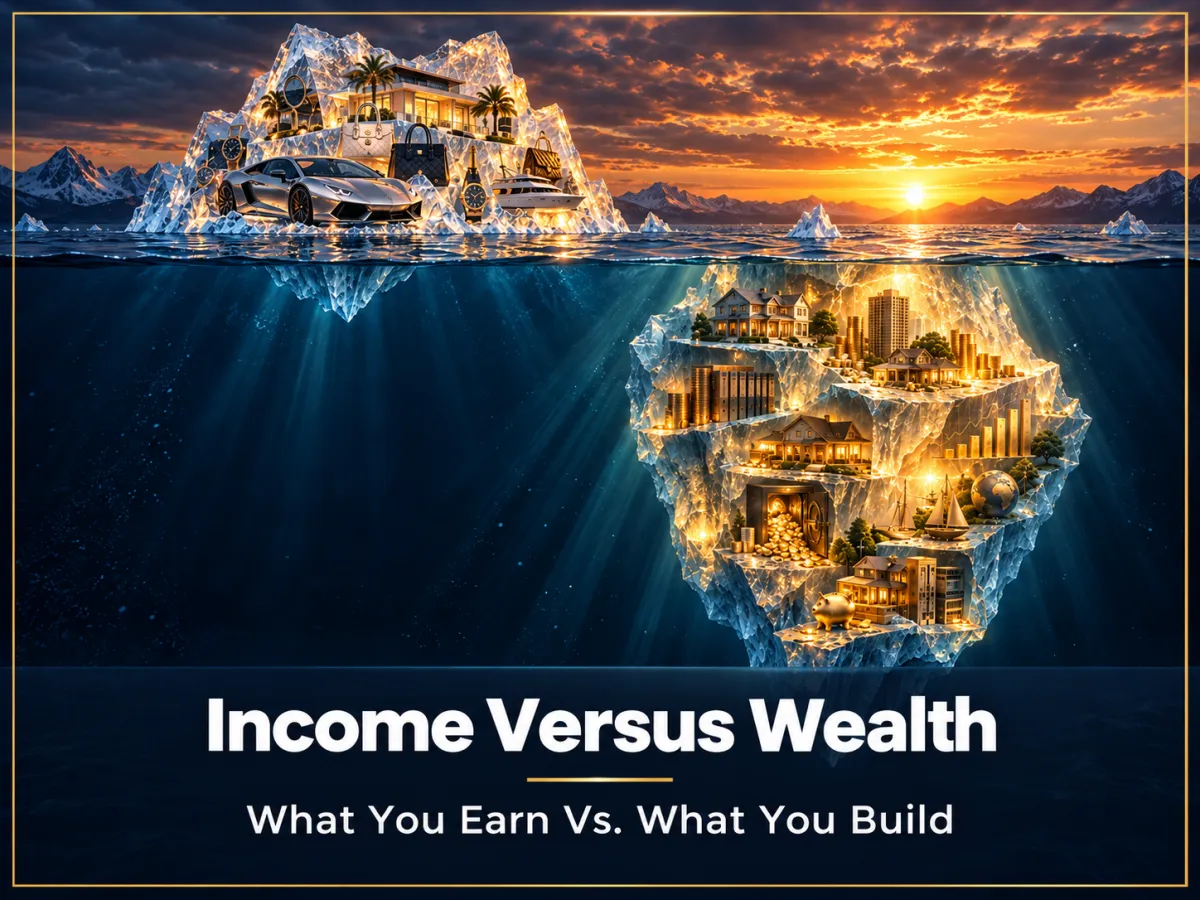
Income Versus Wealth: What You Earn vs. What You Build in 2026
TL;DR: Income and wealth are not the same thing, and confusing them is one of the most common reasons high earners end up with surprisingly little to show for decades of hard work. The distinction is what happens to income after it is earned. Income that flows entirely into consumption leaves no wealth behind. Income converted into assets, through real estate, investments, and retirement accounts, compounds into something that can eventually work alongside you. Contact Peak Capital Mortgage at (970) 577-9200 to talk about what role real estate plays in that progression.
Key Takeaways
Someone earning $500,000 a year can have far less wealth than someone earning $120,000, depending entirely on what each person does with the income after it is earned
The fundamental wealth-building progression is: Labor creates income, income creates capital, capital acquires assets, and assets create wealth
Wealth compounds differently than income: once assets are in place, they can generate returns that get reinvested, growing the asset base without requiring equivalent increases in personal labor
Appreciated assets are not taxed simply because their value increased. Capital gains typically become relevant when an asset is sold, and long-term capital gains can receive different federal tax treatment than ordinary income
Real estate demonstrates the full progression in a single asset: labor income becomes a down payment, the property builds equity through amortization and appreciation, and that equity can eventually be used to acquire the next asset without selling the original
Why Is Income Not the Same as Wealth?
These may sound similar. They are not.
Someone can earn an extraordinary income and have surprisingly little wealth. Someone else can earn a much more modest income and quietly accumulate substantial wealth over several decades.
The difference almost always comes down to what happens to the income after it is earned.
We tend to judge financial success by what we can see. The expensive house. The luxury vehicle. The vacations. The lifestyle.
When someone earns $300,000 or $500,000 a year, we assume that person must be wealthy.
Maybe. But not necessarily.
If someone earns $500,000 and spends nearly $500,000 every year maintaining their lifestyle, they have a high income. But they may not be accumulating much wealth. If the income stops, the lifestyle may have to stop with it.
Now consider someone earning $120,000 who consistently lives below their income and uses part of the difference to acquire assets. They contribute to retirement accounts. They purchase investments. They buy a home and gradually build equity. Perhaps they eventually acquire investment real estate and reinvest some of the income those assets generate.
From the outside, this person may appear considerably less affluent.
Twenty or thirty years later, however, the financial picture can look dramatically different.
One person had tremendous income. The other built tremendous wealth.
What Is the Fundamental Progression from Labor to Wealth?
This is where the progression becomes clear.
Most of us begin with labor. Labor creates income. Then we have a choice about what happens to that income.
We can consume all of it, or we can retain some of it. The portion we retain can be converted into capital. Income creates capital.
That capital can then be deployed to purchase assets. Capital acquires assets.
Those assets can appreciate, produce income, or both. Assets create wealth.
Written simply: Labor creates income. Income creates capital. Capital acquires assets. Assets create wealth.
The objective is not to eliminate consumption along the way. We work partly so we can enjoy our lives. The goal is simply not to interrupt the progression by consuming everything our labor produces.
Why Does Compounding Change Everything Over Time?
This process is rarely exciting in the beginning.
Someone investing their first $5,000 is not going to feel wealthy. The first few years of retirement contributions may seem insignificant. The equity accumulated in the early years of homeownership may not appear life-changing.
But wealth building does not happen in a straight line. It compounds.
Assets can potentially generate returns. Those returns can be reinvested. The larger the asset base becomes, the greater its potential ability to produce additional growth.
Eventually, the assets accumulated years earlier can be creating more wealth without requiring an equivalent increase in personal labor.
That is where the financial equation begins to change. Your labor is no longer doing all the work. Your capital is working too.
How Is Wealth Taxed Differently from Income?
There is another important reason to understand the difference between income and wealth: they are not treated identically under the tax code.
Income is generally taxed as it is earned or received. Wages are subject to federal income taxes and generally payroll taxes, and state income taxes may apply depending on where you live.
Wealth operates differently.
If you purchase an asset for $200,000 and over time it becomes worth $400,000, that increase in value does not necessarily mean you immediately owe federal capital gains tax simply because its market value increased. Capital gains generally become relevant when a capital asset is sold or otherwise disposed of.
Long-term capital gains can also receive different federal tax treatment than ordinary income, depending on the type of asset, holding period, income level, and individual circumstances.
There is another concept that wealthy individuals and investors frequently understand: an asset can sometimes provide access to liquidity without being sold.
If you own real estate with substantial equity or have other assets against which a lender is willing to extend credit, you may be able to borrow against that asset. Loan proceeds are generally not included in gross income because you have an obligation to repay the money. That is different from selling an appreciated asset and potentially realizing a taxable gain.
That does not make borrowing free money. There is interest expense, repayment risk, and the possibility that asset values can decline. Excessive leverage can destroy wealth just as easily as intelligent leverage can help build it.
The important point is understanding that income, appreciation, asset sales, and borrowing are treated differently. Understanding those differences gives you more financial options over time.
How Does Real Estate Demonstrate the Full Progression?
Real estate is one of the clearest examples of how this progression works in a single asset.
You earn income from your labor. You save a portion of that income. You use some of that capital toward purchasing a property.
Over time, you may reduce the mortgage balance while the property potentially appreciates. Now you have equity. That equity becomes part of your net worth.
If it is an investment property, it may also produce rental income.
Eventually, that equity may help you acquire another asset without necessarily selling the original property.
That is the transition from simply earning money to managing capital.
What Should You Do If You Earn Well but Do Not Feel Like You Are Getting Ahead?
If you earn a good income but do not feel as though you are building real financial progress, do not look only at your paycheck.
Look at what your paycheck is creating.
Is it primarily creating a lifestyle? Or is some of it creating assets?
The more realistic path to wealth is not dramatic. Earn. Keep some. Invest it. Acquire productive or appreciating assets. Allow time and compounding to work. Repeat.
None of this requires becoming wealthy overnight. Attempting to do so is one of the fastest ways to make poor financial decisions.
Small, consistent decisions become large outcomes over time. The difference over 20 or 30 years can be enormous.
FAQ
Can someone with a high income have very little wealth? Yes, and it is more common than most people realize. Income is a flow: money that arrives and, if spent, leaves. Wealth is a stock: assets that accumulate and compound over time. A person earning $500,000 who spends $480,000 annually builds far less wealth than a person earning $120,000 who consistently directs a meaningful portion toward productive assets. The gap between those two outcomes grows dramatically over decades.
What does it mean to borrow against an asset instead of selling it? When an asset like real estate has substantial equity, a lender may be willing to extend credit against that equity. The borrower receives proceeds they can use, but because there is an obligation to repay, those proceeds are generally not treated as taxable income the way a sale would be. The original asset remains owned and can continue to appreciate. This is a strategy used by experienced investors to access liquidity without triggering a taxable event, though it comes with real interest costs and risks that must be understood and managed.
How does real estate fit into a long-term wealth-building strategy? Real estate provides multiple wealth-building mechanisms in a single asset: forced savings through amortization (each payment reduces the balance), potential appreciation over time, rental income if the property is an investment, tax advantages including depreciation, and the ability to leverage equity to acquire additional assets. For many households, a primary residence becomes the foundation of wealth accumulation, and investment properties extend that foundation further.
The Bottom Line
Income is what flows through your financial life. Wealth is what you manage to retain and build. The progression from labor to income to capital to assets to wealth is not complicated in concept. The difficulty is sustaining the discipline to not consume everything the progression produces. Real estate has been one of the most powerful vehicles for making that progression tangible because it forces capital to work, builds equity with every payment, and creates compounding value over time. Ready to explore how real estate fits into your wealth-building progression? Contact Peak Capital Mortgage to explore your options.