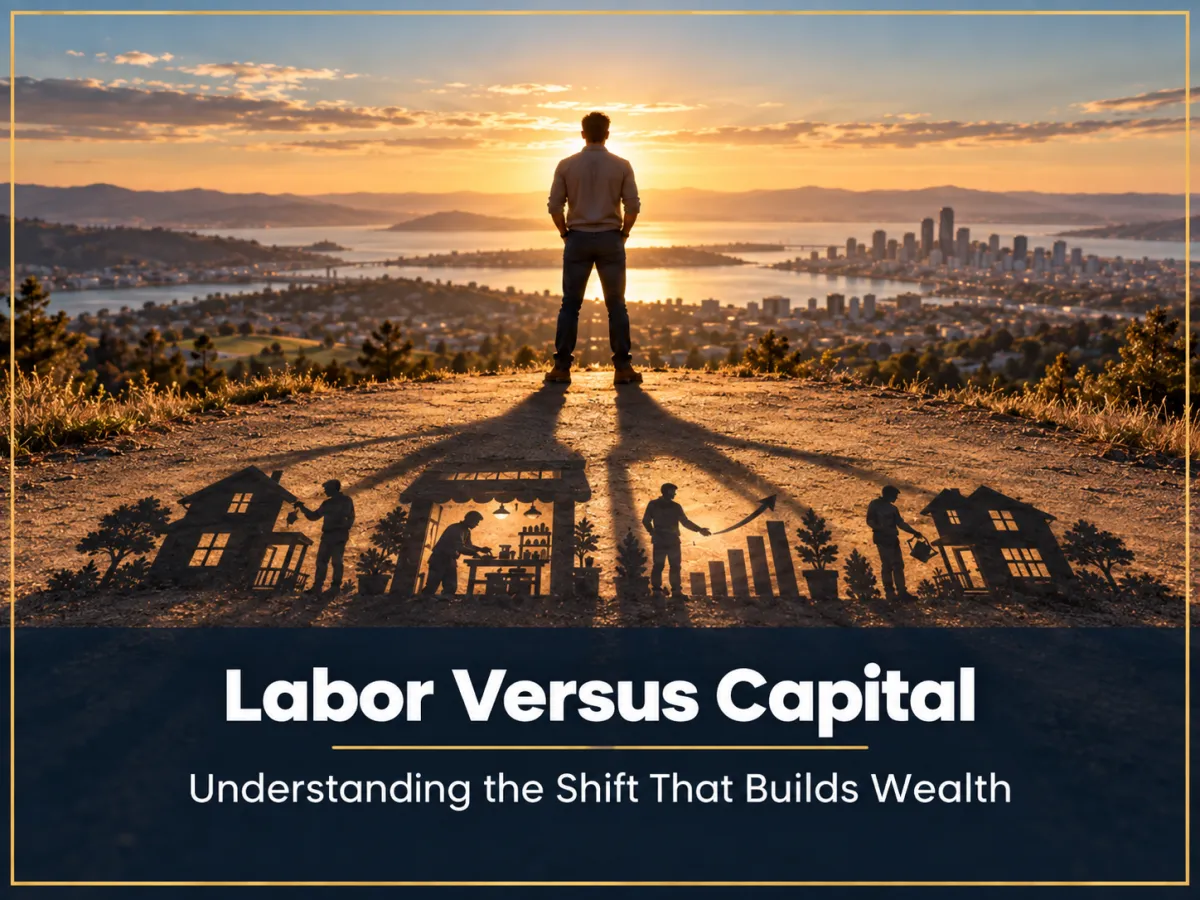
Labor Versus Capital: Understanding the Shift That Builds Wealth in 2026
TL;DR: Most people begin their financial lives entirely dependent on labor, exchanging time and skill for income. That is where financial life starts, not where it has to end. The shift that builds lasting wealth is converting a portion of what your labor earns into capital: assets that can generate income, appreciate, and eventually work alongside you. Real estate is one of the most accessible ways to make that transition. Contact Peak Capital Mortgage at (970) 577-9200 to explore how it fits into your picture.
Key Takeaways
Labor is how nearly everyone begins their financial life, but relying entirely on labor income creates a ceiling because there is only one of you and only so many hours available
Capital is money or assets that can potentially produce additional economic value without requiring your direct time, including stocks, real estate, businesses, retirement accounts, and intellectual property
The wealth-building transition happens when you begin converting income from labor into capital, even in small percentages, and allow that capital to compound over time
Financial optionality, the ability to work fewer hours, weather income disruptions, or make choices based on preference rather than necessity, is what capital accumulation actually builds
Labor and capital are not taxed identically under current law: long-term capital gains can receive preferential federal rates compared to ordinary income, making understanding the tax rules an important part of wealth strategy
Why Does Financial Life Begin With Labor?
For most people, financial life begins with labor.
You go to work. You provide a skill, service, knowledge, or physical effort, and someone pays you for the value you create. Whether you are an employee, business owner, salesperson, contractor, physician, teacher, tradesperson, or mortgage professional, you are exchanging some combination of your time and ability for income.
There is nothing wrong with that. Labor is where almost everyone begins.
The mistake is believing that labor should also be where the financial journey ends.
This is a continuation of the conversation about production versus consumption. A healthy personal financial life, like a healthy economy, cannot be built entirely around consuming what you earn. The next question is, what are you doing with what you produce?
What Is the Inherent Limitation of Labor Income?
There is a fundamental constraint built into relying entirely on labor for income.
There is only one of you.
You only have so many hours in a day, so many days in a year, and eventually only so many years during which you will want, or be able, to work at the same pace.
You can increase the value of your labor. You can develop new skills, become more productive, start a business, earn promotions, or use technology to accomplish more.
But ultimately, labor has a ceiling.
What Is Capital, and Why Does It Matter for Wealth Building?
Capital begins changing that equation.
Capital is money or assets that can potentially produce additional economic value. Stocks, businesses, investment real estate, retirement accounts, equipment, and intellectual property are all examples of capital in various forms.
The wealth-building transition occurs when you begin taking some of the income generated by your labor and converting it into capital.
Suppose you earn $100 and consume the entire $100. You received value for your labor, but financially you are essentially back where you started. To generate another $100, you have to go back to work.
Now imagine instead that you consume $85 and invest $15. That $15 has now been converted from labor income into capital.
Perhaps it purchases shares in a company. Perhaps it goes toward a retirement account. Perhaps it becomes part of the down payment on an investment property. Perhaps it helps fund a business.
Now you potentially have something working alongside your labor.
Repeat that process month after month and year after year, and something important begins to happen. Your assets can start generating returns of their own. Dividends can be reinvested. Businesses can generate profits. Real estate can potentially produce rental income and appreciate. Investment accounts can compound.
Eventually, a portion of your financial life is no longer dependent solely on how many hours you personally worked that month.
That is a meaningful transition.
What Does Financial Optionality Actually Mean?
Sometimes people hear discussions about investing or passive income and assume the objective is to stop working as quickly as possible.
That is not the best way to look at it.
The goal is to create financial optionality.
When labor is your only source of income, you have relatively few choices. If your paycheck stops, your income stops.
When you gradually build capital, you begin creating additional sources of financial support.
Perhaps investment income eventually supplements your salary. Perhaps a rental property helps fund retirement. Perhaps your investment portfolio gives you the ability to work fewer hours later in life. Perhaps accumulated assets allow you to help your children or grandchildren.
Capital creates choices.
And those choices usually take decades to build, which is exactly why starting earlier matters more than the amount you start with.
How Are Labor and Capital Taxed Differently?
There is another distinction between labor and capital that is worth understanding: they are not always taxed the same way.
Income from employment is generally subject to both income tax and payroll taxes. Investment income is taxable as well, but different types of investment income are treated differently under the tax code.
One of the most familiar examples involves long-term capital gains. Under current federal law, gains on qualifying investments held longer term can receive preferential federal rates compared with ordinary income tax rates, depending on the taxpayer's income and circumstances. The IRS maintains separate long-term capital gain thresholds at 0 percent, 15 percent, and 20 percent for federal purposes.
That does not mean capital is untaxed. Interest, dividends, rental income, business income, short-term gains, long-term gains, depreciation recapture, and other investment-related income can all receive different treatment. State taxation also varies.
The broader lesson is to understand the rules of the financial system you are operating within. We can debate how the tax code should be structured, but for your own financial planning, you have to operate within the rules that exist today. Understanding them allows you to make more informed decisions.
How Do You Start Converting Labor Into Capital?
If you feel as though you are working hard but not getting ahead, look at where the income from your labor is actually going.
How much is being consumed? How much is being converted into assets?
The percentage does not have to be large when you begin. What matters is developing the habit and sustaining it.
Your first investment may seem insignificant. Your first retirement contribution may feel small. The equity in your first home may not look impressive. Your first investment property may take years to acquire.
But wealth accumulation is rarely about one dramatic financial move. It is the result of repeatedly converting today's labor into tomorrow's capital.
Over time, the goal is to move from a financial structure where you work for all of your money to one where you work for money, and some of your money and assets also work for you.
That is one of the fundamental differences between earning a good income and actually building wealth.
Labor is where most people begin. Capital is how people begin creating financial independence.
FAQ
What is the difference between labor income and capital income? Labor income is earned through direct personal effort: wages, salaries, fees, and self-employment income. Capital income is generated by assets you own: dividends, rental income, business profits, investment appreciation, and interest. The key distinction is that capital income does not require your direct time to generate, which is what makes it the mechanism for building financial independence over time.
How does real estate function as capital? Real estate is a productive capital asset in two ways. A rental property generates cash flow from tenants and can appreciate over time. A primary residence builds equity through amortization, which is the paydown of principal, and through market appreciation. Both produce value without requiring the owner to trade time for that return in the way labor does. Real estate can also be leveraged, which amplifies the return on the capital invested.
How much of my income should I convert to capital? There is no universal percentage, but the habit of consistently directing some portion of earned income toward assets is more important than the specific amount when you start. Starting with even a small percentage, five to ten percent, and increasing it as income grows can compound into substantial capital over a 20 to 30-year horizon. What matters most is starting, sustaining the habit, and ensuring the assets you acquire have the potential to produce future income or appreciation rather than simply depreciate.
The Bottom Line
Labor is where almost everyone starts. It is honorable, necessary, and the foundation of everything that follows. But labor alone has a ceiling, and relying entirely on it leaves your financial future dependent on your ability to keep showing up. Capital is what eventually starts working alongside you. Every asset you acquire, every investment you make, and every portion of today's earnings you redirect toward something productive instead of something consumable is a step toward a financial life that does not depend entirely on what you can personally produce today. Ready to explore how real estate fits into your labor-to-capital transition? Contact Peak Capital Mortgage to explore your options.