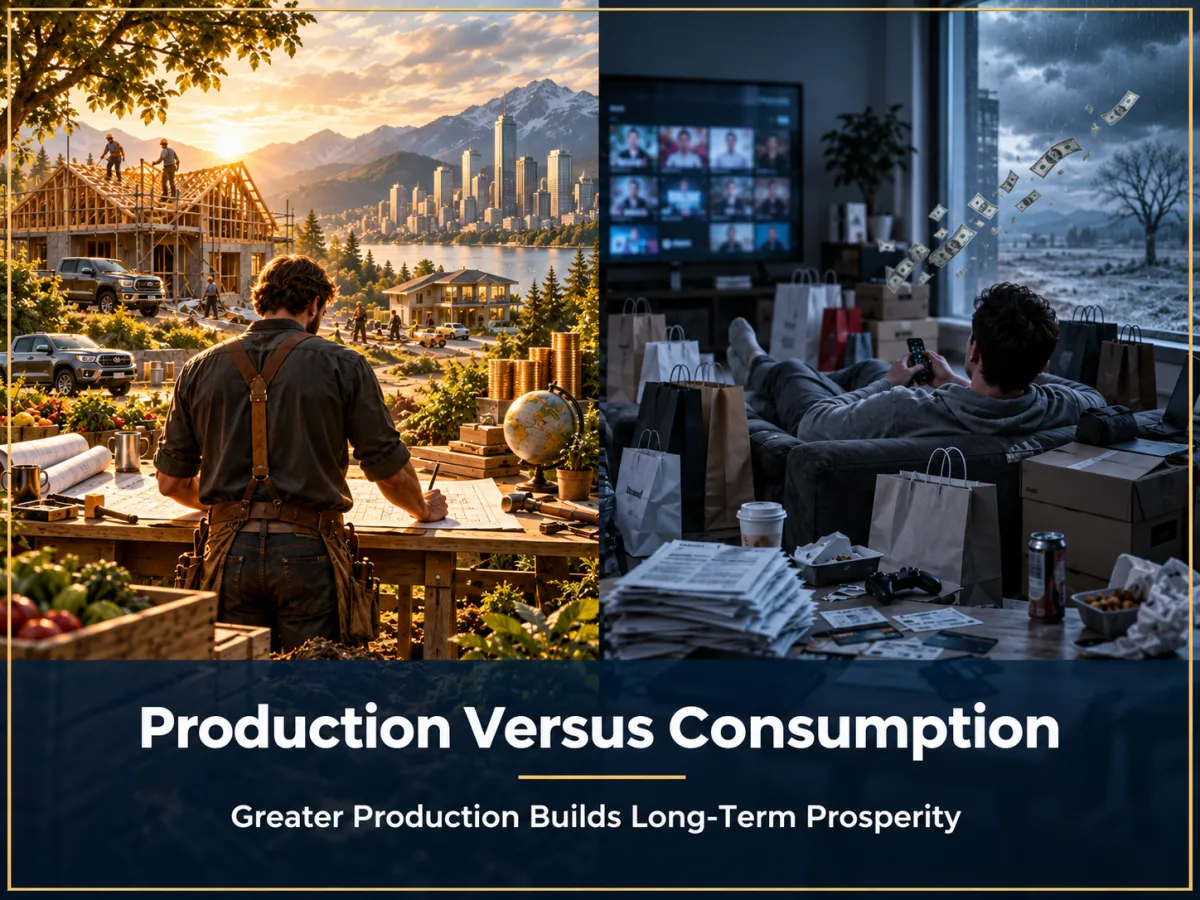
Production Versus Consumption: Why What You Create Matters More Than What You Spend in 2026
TL;DR: We live in a world designed around consumption, but lasting wealth is built through production. The more value you create for others, whether through skills, businesses, real estate, or productive investments, the greater your own economic opportunity becomes. Societies and individuals that produce more tend to prosper more. The question is not how much you are spending. It is how much you are creating. Contact Peak Capital Mortgage at (970) 577-9200 to talk through how real estate fits into your production strategy.
Key Takeaways
Consumption is essential to a functioning economy, but long-term prosperity depends on how much value an economy, a business, or an individual is actually capable of producing
Increasing personal productivity, through skills, technology, AI tools, business development, or investment, creates greater value without necessarily requiring more hours worked
Production and supply are the underappreciated sides of the inflation equation: when the supply of housing, energy, food, and goods grows to meet demand, pricing pressures moderate naturally
You cannot consume your way to wealth: lasting financial progress requires directing a portion of productive income toward assets that can generate future income or appreciation
Real estate is one of the clearest examples of a productive asset: it can generate rental income, appreciate over time, and build equity while the mortgage amortizes
Why Does the Balance Between Production and Consumption Matter?
We live in a world built around consumption.
Every day, we are encouraged to buy something, upgrade something, subscribe to something, finance something, or replace something we already own. Advertising follows us everywhere. Social media constantly introduces us to another product, service, trip, vehicle, home improvement, or lifestyle we might want.
Consumption is not inherently bad. It is an essential part of a functioning economy. Businesses need customers. Workers need businesses to sell products and services so they can remain employed. Money has to circulate.
But there is another side of the equation that does not receive nearly as much attention.
Production.
Before something can be consumed, someone has to create it. Someone has to build the house, grow the food, manufacture the equipment, write the software, provide the financing, repair the vehicle, develop the technology, transport the products, provide professional services, or create something else that another person finds valuable.
That distinction between production and consumption is important because long-term prosperity ultimately depends on how much value an economy is capable of producing.
What Is Personal Economic Utility, and Why Does It Matter?
One useful way to think about this is through the concept of utility.
What value do you provide? What problem do you solve? What product, service, knowledge, expertise, or skill do you bring to your employer, your customers, your community, or the broader economy?
The greater the value you are capable of creating, the greater your own economic opportunities can become.
That may mean becoming more skilled at your profession. It may mean learning how to use artificial intelligence and technology to become more productive. It could mean starting a business, developing a new service, investing in real estate, improving a property, creating intellectual property, or simply becoming substantially better at what you already do.
Increasing your productivity allows you to create greater value without necessarily increasing the amount of time you work.
If one farmer can produce more food, one builder can construct homes more efficiently, one manufacturer can produce more products, or one business can serve more customers using the same amount of labor and resources, society effectively becomes wealthier. There are more goods and services available to everyone.
How Does Production Help Keep Prices Stable?
This relationship also helps explain inflation.
When demand for something grows faster than the ability to produce it, prices tend to rise.
Imagine 100 families trying to purchase 50 available homes. Competition pushes prices higher.
Now imagine 100 families with 120 homes available. Buyers have choices, sellers face competition, and pricing pressures begin to moderate.
The same basic principle applies throughout the economy. Energy, housing, food, transportation, technology, healthcare, and thousands of other products and services are all affected by the relationship between supply and demand.
We frequently focus on the demand side of inflation. People are spending too much. Interest rates are too low. Government spending is too high. All of those factors can matter.
But there is another solution that deserves more attention: produce more.
More housing. More energy. More technology. More food. More businesses. More infrastructure. More productive workers.
When productivity and supply increase, an economy has a better opportunity to meet demand without relying entirely on higher prices to balance the marketplace.
Who Ultimately Produces What Public Services Consume?
This also becomes important when discussing services funded by the government.
People often refer to programs as free, but economically, very little is truly free. If the government provides a service, someone ultimately produces that service, and someone ultimately provides the resources to pay for it.
Those resources generally come from taxes, borrowing, fees, or other forms of government revenue.
That does not mean public-sector workers are unproductive. Teachers, police officers, firefighters, infrastructure workers, military personnel, and many other government employees provide services that can be extremely valuable to a functioning society.
The broader economic question is one of balance. A society needs a sufficiently large and productive private economy generating income, profits, goods, services, investment, and tax revenue to sustainably support the public services that society wants. The stronger that productive base becomes, the more choices a society can afford. The weaker that base becomes, the more difficult those choices eventually get.
Can You Consume Your Way to Wealth?
The short answer is no.
A person who uses income entirely for consumption continually starts over. Every dollar earned is a dollar spent, and at the end of the month there is nothing to show for it beyond whatever was purchased.
A person who directs part of their productive income toward assets begins creating something different. Those assets might include businesses, investments, retirement accounts, real estate, or other productive resources capable of generating future income or appreciation.
Over time, those assets can begin producing alongside you.
That is when personal finance begins shifting from simply earning money to building wealth. The income from assets eventually supplements earned income. With enough productive assets, the assets begin to carry more of the financial load on their own.
This is also why real estate has historically been one of the most powerful wealth-building tools available. A rental property is a productive asset. It generates income. It can appreciate over time. The mortgage amortizes, and equity builds. One asset can eventually help fund the next.
What Should You Ask Yourself About What You Produce?
There is a useful question each of us can occasionally ask.
What am I producing that creates value for someone else?
And then one step further: how can I increase that value?
Perhaps you can solve a problem faster. Serve more customers. Improve a process. Learn a new technology. Create a business. Develop another income stream. Invest in an asset. Teach someone else a valuable skill.
The objective is not to eliminate consumption. Life should be enjoyed, and consumption is part of that.
The objective is balance.
The healthiest households, businesses, communities, and economies are not built entirely around consuming more. They are built around producing more value. Because when we increase what we are capable of producing, we create greater abundance. Greater abundance creates more opportunity. More opportunity creates greater access to goods and services.
That is how societies and individuals become wealthier. Not by dividing what already exists, but by continually creating more value for everyone.
FAQ
What is the difference between consumption and production in personal finance? Consumption is spending money on goods and services you use or experience. Production is creating value for others through work, business, or ownership of productive assets that generate income or appreciation. A financially healthy individual does both but prioritizes directing a meaningful portion of income toward assets that produce future value rather than spending everything on current consumption.
How does real estate fit into a production-focused financial strategy? Real estate is one of the clearest examples of a productive asset available to individual investors. A rental property generates income. A primary residence builds equity through amortization and appreciation. Both can be leveraged to fund additional assets over time. Unlike a car or a depreciating purchase, real estate has historically produced value alongside the owner rather than simply declining in value after purchase.
How does increased production help reduce inflation? Inflation is driven by the relationship between supply and demand. When demand for housing, food, energy, or goods grows faster than the supply, prices rise. When production and supply increase to meet demand, pricing pressures naturally moderate. That is why productivity growth, AI adoption, homebuilding, and business investment are not just economic abstractions. They affect what everyday goods and services cost.
The Bottom Line
You cannot consume your way to wealth. The people, businesses, and societies that build lasting prosperity are the ones that focus on producing more value, not just spending more of it. Every skill you develop, every asset you acquire, every business you build, and every productive investment you make adds to your economic utility. Real estate has been one of the most reliable productive assets in American history for exactly that reason. Ready to add a productive asset to your financial picture? Contact Peak Capital Mortgage to explore your options.